
It's Our Damn Money — The Rebel's Complete Guide to Social Security
I am not a financial advisor. I am not a Social Security expert. I am a woman who will turn 62 in November, whose husband is 63 and still working full time, and who has spent considerable time going back and forth — 62 or 67? Take it now or wait? What about his benefit? What about mine? What does any of this actually mean? I went looking for answers. Here is everything I found — in plain English, with no acronyms left unexplained and no women left behind.
💡 This post is for informational purposes only and does not constitute financial advice. Please consult a qualified financial advisor for guidance specific to your situation.

Let me start with something that makes my blood boil.
The government calls Social Security an entitlement.
Entitled my — well. You know what I mean.
This is not charity. This is not a handout. This is not the government doing us a favor. Like that JG Wentworth commercial — it's our money and we want it now. We paid it into the system — every single paycheck, for decades — with the understanding that the government would hold it safely and return it to us when we needed it. Like a bank. Except the bank has the nerve to act like they're doing us a kindness when we ask for our own money back.
My husband and I have printed our Social Security statements every single year since our fifties. We have watched those numbers grow. We have planned around those numbers. We have argued about those numbers over dinner more times than I can count.
62 or 67? Now or later? His benefit or mine? Both? Either? How does any of this work?
If you are in the same boat — and statistically speaking most women our age are — this post is for you.
What Social Security Actually Is
Social Security retirement benefits are monthly payments from the government based on your earnings history. The more you earned over your working life and the longer you worked the higher your benefit. The SSA calculates your benefit using your highest 35 earning years. If you worked fewer than 35 years they fill in zeros for the missing years which reduces your benefit. This is why career gaps — caregiving years, raising children — disproportionately hurt women's Social Security benefits.
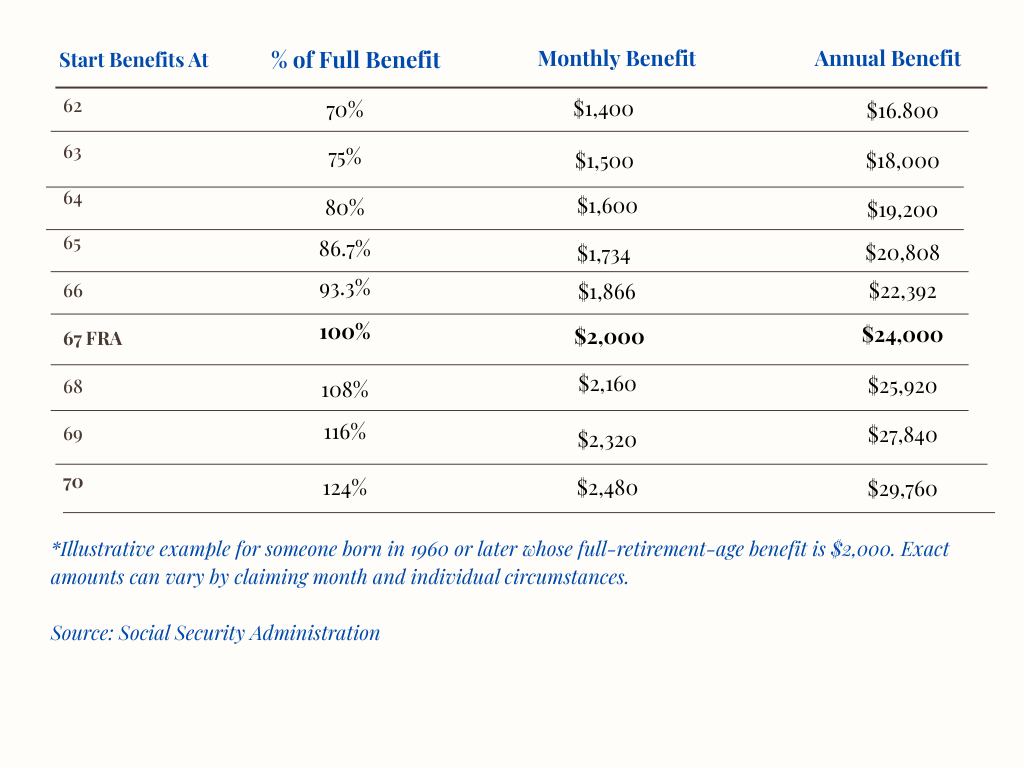
Your benefit is calculated as a percentage of your PIA — Primary Insurance Amount — which is the monthly payment you would receive if you claimed at exactly your FRA — Full Retirement Age. For anyone born in 1960 or later Full Retirement Age is 67.
Everything else — claiming early or late — is calculated as a percentage of that FRA amount.
The Numbers — And They Are Not Small

As of 2026 the maximum monthly Social Security benefit is $2,969 if you claim at age 62, rising to $4,207 at full retirement age of 67, and reaching a peak of $5,181 if you wait until age 70. That is a $2,212 monthly difference between the earliest and latest possible claiming ages.
Most of us will not receive the maximum — those numbers assume you earned at or near the taxable wage cap for 35 years. But the percentages apply to everyone. Here is what they look like assuming your FRA benefit is $2,000 per month:
62 or 67 — The Question We All Lose Sleep Over
Honest answer — there is no single right answer. Here is what actually drives the decision.
The Break Even Point
For most retirees in average or better health claiming at 67 or 70 produces more lifetime income than claiming at 62. The break-even point is roughly age 78 for 62-versus-67 and roughly age 82 for 67-versus-70.
In plain English. If you claim at 62 and live past 78 you would have received more total money by waiting until 67. If you live past 82 waiting until 70 would have been better.
The Case for Claiming at 62:
You need the income now- health reasons, job loss, caregiving
Your health suggests a shorter than average lifespan
You want to stop depleting your savings while waiting
Your spouse is the higher earner and will delay to maximize survivor benefits
The Case For Waiting:
You are healthy and expect a long life
You or your spouse are still working and income is not urgent
You want to maximize your monthly payment for life
You want to maximize the survivor benefit for your spouse
COLA compounding on a higher base is real money over decades
My Honest Opinion:
My husband and I are still debating this. He is 63 and working full time. I turn 62 in November. We go back and forth constantly. What I know for certain is that this decision deserves real thought, a printed Social Security statement and probably a conversation with a fee-only financial advisor who can run the actual numbers for your specific situation.

The Earnings Test — If You’re Still Working
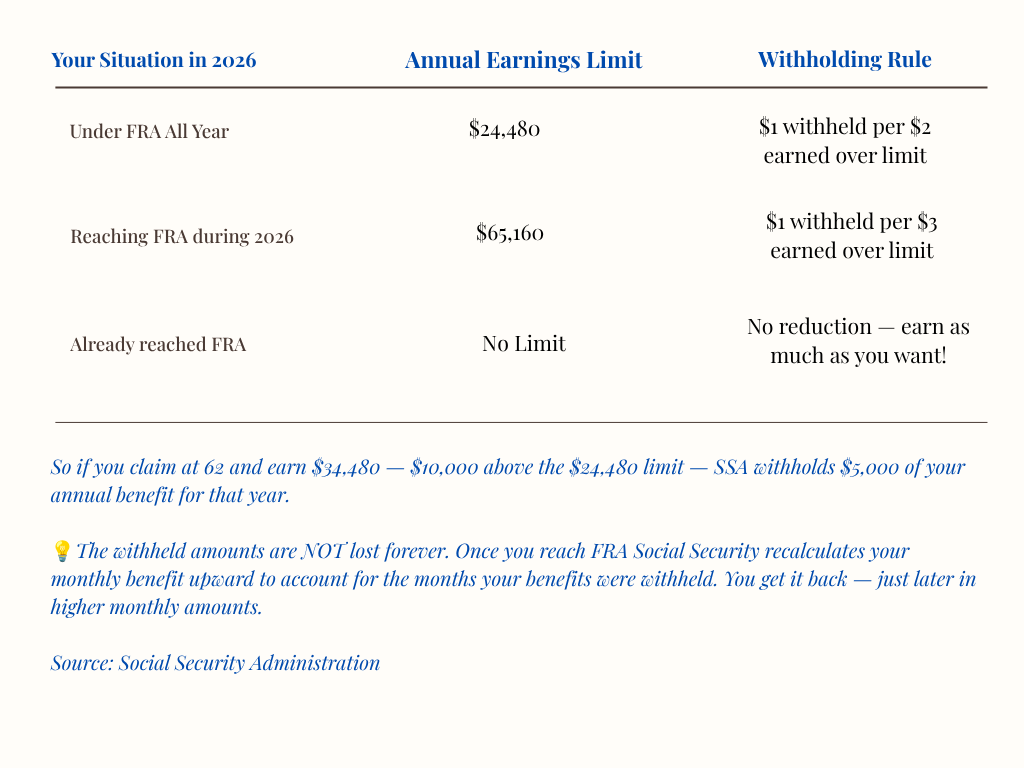
You CAN collect Social Security while still working. But there are important limits before you reach FRA.
Spousal Benefits — What Every Woman Needs to Know
30% of adults incorrectly believed Social Security does not offer benefits for a spouse. And 50% incorrectly believed that divorced women cannot claim on an ex-spouse's record. Those knowledge gaps could lead to costly financial mistakes.
The Maximum Spousal Benefit:
The maximum spousal benefit is 50% of your spouse's Primary Insurance Amount — the benefit they would receive at their full retirement age. If your husband's FRA benefit is $3,000 per month your maximum spousal benefit is $1,500 per month.
You can only receive a spousal benefit if it is worth more than your own retirement benefit. SSA automatically pays you the higher of the two. You do not get both.
The Timing Catch:
The higher-earning spouse must be actively receiving Social Security before the lower-earning spouse can claim the spousal benefit. If your husband delays until age 70 you cannot collect the spousal benefit until he actually turns his benefits on.
💡 This one rule drives many married couples' filing decisions. It is driving ours. Think carefully about the timing before either of you files.
Claiming Spousal Benefits Early:
You can claim spousal benefits as early as 62 but doing so reduces your checks by up to 35% — enough to drop a $1,000 benefit to $650 per month.
Critical Difference from Your Own Benefit:
Unlike your own retirement benefit spousal benefits do NOT increase past your FRA. There is no advantage to delaying a spousal benefit past age 67 — they will not grow. The optimal claiming age for a spousal benefit is Full Retirement Age.
For Divorced Women:
If you are divorced you may be eligible for Social Security benefits based on your ex-spouse's record — even if they have remarried — as long as the marriage lasted at least 10 years and you are currently unmarried. You do not have to wait for your ex-spouse to file. Half of surveyed adults did not know this. Now you do.
And while you're thinking about protecting what's yours — have you read our estate planning guide? Every woman needs a plan in place before she needs one."
How to Read Your Social Security Statement
My husband and I have printed ours every year since our fifties. If you have never done this — do it today. It takes five minutes and it will show you exactly what you have earned.
How to Get Your Statement:
Go to ssa.gov/myaccount and create a My Social Security account. Your statement is available immediately online. For workers age 60 and older who do not have an online account SSA mails statements three months prior to your birthday.
The SSA has official sample statements you can view before you even log in:
‣ Online Statement Sample: ssa.gov/myaccount/assets/materials/statement-redesign-online.pdf
‣ Mailed Statement Sample: ssa.gov/myaccount/assets/materials/statement-redesign-si-bw.pdf
Open those links and follow along with the guide below.
The Statement Decoded — What You Are Looking At:
Section 1 — Your Estimated Benefits
The bar graph at the top showing your estimated monthly benefit at different claiming ages. This is your most important number. Write it down. Compare it to 50% of your spouse's benefit. The higher number is where you start planning.
Section 2 — Your Earnings History
Every year you worked and how much you earned as reported to the SSA. Check it for accuracy. Errors happen and they permanently affect your benefit. If a year shows zero earnings and you know you worked that year contact the SSA immediately.
Section 3 — Your Benefits at 62, 67 and 70
Three specific numbers shown clearly. Think of them as three doors:
‣ Door 1 — Age 62: Smallest monthly check. Most years of collection.
‣ Door 2 — Age 67: Your full benefit. 100% of what you earned.
‣ Door 3 — Age 70: Largest monthly check. Fewest years of collection.
Section 4 — Survivor and Disability Benefits
What your family would receive if you became disabled or died. Important to review especially if you have a spouse or dependents.
Section 5 — Medicare Information
When you become eligible and what to do. Medicare at 65 is separate from Social Security — you can claim one without the other.
Check These Things Every Year:
☐ Are all your working years showing income? Any zeros that shouldn't be?
☐ Do the earnings amounts look approximately right for what you remember earning?
☐ Has your benefit estimate changed since last year?
☐ Does your spouse's statement show the same accuracy?
💡 Errors in your earnings record are more common than you think and they directly reduce your lifetime benefit. The SSA gives you the tools to catch and fix them — use them every year.
The Rebel's Glossary — Social Security Alphabet Soup Decoded

The Social Security glossary is dotted with abbreviations like FRA, AIME, PIA and COLA that are key to determining your payment amounts. Here they all are in plain Rebel Age English, because no one has a degree in government speak.
SSA — Social Security Administration. The government agency running the whole show. Website: ssa.gov. Phone: 1-800-772-1213.
FRA — Full Retirement Age. For anyone born in 1960 or later this is age 67. The age at which you receive 100% of your earned benefit — no reduction, no bonus.
PIA — Primary Insurance Amount. Your base benefit — the monthly payment you would receive if you claimed at exactly your FRA. Everything else is calculated as a percentage of this number. The most important number on your statement.
COLA — Cost of Living Adjustment. The annual increase to your benefit based on inflation. In 2026 the COLA increased benefits by 2.8 percent. This compounds on your base — a higher base means more money every January for the rest of your life.
AIME — Average Indexed Monthly Earnings. The formula SSA uses to calculate your PIA from your earnings history. They take your highest 35 earning years, adjust for inflation and average them. SSA calculates this for you.
DRC — Delayed Retirement Credits. The 8% annual bonus you earn for every year you wait past your FRA up to age 70. Wait three years past 67 and your benefit increases by 24% permanently.
QC — Quarter of Coverage. A unit of credit you earn by working and paying Social Security taxes. You need 40 QCs — approximately 10 years of work — to qualify for retirement benefits.
CPI-W — Consumer Price Index for Urban Wage Earners and Clerical Workers. The inflation measure used to calculate your annual COLA. Means: how much did prices go up this year.
Earnings Test — The rule that temporarily reduces your benefit if you claim before FRA and continue working above the annual limit. In 2026: $24,480 if under FRA all year. $65,160 in the year you reach FRA. Gone completely once you reach FRA.
Survivor Benefit — If your spouse dies you may receive their Social Security benefit instead of your own — up to 100% of what they received. One of the most important reasons higher-earning spouses delay claiming — to maximize what a surviving spouse receives for life.
Spousal Benefit — Up to 50% of your spouse's PIA. Available to current spouses and qualifying ex-spouses. Cannot exceed your own benefit — SSA pays the higher of the two automatically.
IRMAA — Income Related Monthly Adjustment Amount. If your income exceeds certain thresholds your Medicare Part B and D premiums increase. Relevant when planning your retirement account withdrawal strategy.
My Social Security Account — Your online account at ssa.gov/myaccount. Create one today. It shows your earnings history, your benefit estimates, your statement and lets you manage everything online.
Your Social Security Action Plan — This Weekend
Step 1
Go to ssa.gov/myaccount and create your account.
Step 2
Download and print your Social Security statement.
Step 3
View the official SSA sample statement at ssa.gov/myaccount/statement.html to understand what you're reading.
Step 4
Check your earnings history line by line for accuracy. Any year showing zero that shouldn't? Contact SSA immediately.
Step 5
Write down your three key numbers: benefit at 62, at 67 and at 70.
Step 6
Ask your spouse to do the same. Then compare the numbers side by side.
Step 7
Compare your FRA benefit to 50% of your spouse's FRA benefit — which is higher?
Step 8
Use the SSA's Retirement Estimator at ssa.gov/benefits/retirement/estimator.html to model different claiming scenarios.
Step 9
Consider consulting a fee-only fiduciary financial advisor to run your specific numbers before filing.
The Bottom Line

I still do not have a definitive answer on whether my husband and I will take our benefits at 62 or wait. We print the statements. We run the numbers. We discuss it over dinner.
What I know is this:
This money is ours. We earned it. We paid it in for forty years. We deserve to understand exactly how to get every dollar of it back — at the right time, in the right amount, in the way that serves our lives best. And while you're auditing your Social Security situation — have you checked what hidden fees are quietly eating your 401K? That post will make your blood boil too.
The SSA website is a labyrinth of acronyms and fine print. But the tools are there if you know where to look — and now you do.
If you want to go deeper I cannot recommend highly enough the book by Laurence Kotlikoff, Get What Yours— the definitive guide to maximizing your Social Security benefits.
So figure it out. Share what you learn. Help each other navigate.
That is what The Rebel Age is for.
It is our damn money. Let's make sure we get all of it.
Expert Sources
‣ SSA Benefits Planner — Retirement: ssa.gov/benefits/retirement/
‣ SSA Sample Social Security Statement: ssa.gov/myaccount/statement.html
‣ SSA Earnings Test 2026: ssa.gov/cola/
‣ Maximum Social Security Benefits 2026 — 24/7 Wall St
‣ Spousal Social Security Benefits 2026 — The Motley Fool
‣ Six Changes to Social Security in 2026 — Kiplinger
‣ Social Security Glossary — AARP: aarp.org/social-security/glossary-of-terms/
With Rebel Love — Jeannie
Are you 62 versus 67? Still debating? Already decided? Have you ever found an error on your statement? Tell me everything in the comments. Every Rebel who figures this out should bring another one with her.
This post is for informational purposes only and does not constitute financial advice. Please consult a qualified Social Security specialist or fee-only financial advisor for guidance specific to your situation.