Estate Planning - What I Knew and What I Didn’t
I Thought I Had This Handled. My Sister Showed Me I Didn't.
This post contains affiliate links. If you purchase through my link I earn a small commission at no extra cost to you. I only ever recommend products I personally use and genuinely believe in.
I had an estate plan. I had amended it twice. I was, I believed, completely prepared. Then my sister asked me to be the executor of her estate and showed me a single document that changed everything I thought I knew about being organized.
I want to talk about something that nobody wants to talk about.
Not because it's morbid. Not because it's depressing. But because I was given a single, perfectly organized document and realized that despite having an estate plan — a real one, professionally prepared, amended twice over the years — I was not nearly as prepared as I thought I was.
This is the post I wish someone had written for me before that moment.
Consider this me writing it for you.
How I Thought I Had This Handled
My husband and I created our estate plan when our children were young. We sat with a professional, we made the difficult decisions, we signed the documents. We felt responsible and prepared and thoroughly adult about the whole thing.
Over the years, as our children grew and our properties changed, we amended it twice. Two amendments. We were practically estate planning veterans.
Then my sister called.
She was getting her affairs in order, and she wanted me to be the executor of her estate. I said yes immediately — of course I said yes — and prepared to bring my considerable estate planning expertise to bear on the situation.
What I learned from my sister was not what I expected.
The Document That Changed Everything
My sister is, it turns out, extraordinarily organized. The kind of organized that makes other organized people, like me feel slightly inadequate.
She had one document.
One single, beautiful, comprehensive document that listed every insurance policy she owned — with the institution name, the address, the phone number and the account number. Every financial account — same details, same completeness. Every online account — including the passwords. Every important contact. Everything, in one place, in a format that meant that whoever was navigating her affairs after she was gone would never have to search for a single thing.
I sat with that document, and I felt two things simultaneously.
The first was profound admiration for my sister.
The second was the dawning, slightly uncomfortable realization that if something happened to me and my husband tomorrow, the people left to sort out our affairs would have a significantly less pleasant experience than my sister was providing for me.
What I Found When I Actually Looked
Here is the thing about estate plans that nobody warns you about: creating one is the beginning, not the end. Life keeps moving. Accounts are opened. Policies change. Properties are bought and sold. And if you are not actively maintaining your estate plan the way you maintain your home or your garden or your health, it quietly becomes out of date without you ever noticing.
When I sat down to do my own version of my sister's document, following her lead, I found accounts I had forgotten to add on my last update.
Accounts. That I had forgotten. Existed.
This is not a reflection of negligence. This is a reflection of the fact that we accumulate financial lives over decades, and we do not always do the administrative work of keeping track of what we have accumulated. Most of us don't. Most of us think we're on top of it until we sit down and discover that we are, in fact, slightly under it.
I am now closing that gap, one organized page at a time.
The Rebel Age Guide to Estate Planning — Start Here
Let me walk you through exactly what you need, in the order you need to do it. I am not a lawyer or a financial advisor — please work with professionals for the legal and financial pieces. But I am a woman who has been through this process, watched her sister do it brilliantly, and wants to give every reader a clear starting point.
Step 1 — Get the Core Documents in Place
These are the non-negotiables. If you have none of the following, start here before anything else:
A Will — the foundational document that dictates what happens to your assets and, if relevant, who cares for your dependents. Without a will, the state decides. The state does not know you. The state has never met your family. Do not let the state decide. And while you're getting organized — make sure you understand your Social Security options too.
A Durable Power of Attorney for Finances — this designates someone to manage your financial affairs if you become unable to do so yourself. Without this document, your family may have to go to court to get the authority to pay your bills or manage your accounts. With it, they simply step in.
A Healthcare Directive — also called a living will or healthcare proxy. This document tells medical professionals and your family what your wishes are regarding medical treatment if you cannot communicate them yourself. It is one of the most important and most commonly overlooked documents in estate planning.
A Trust, if appropriate — a revocable living trust can help your estate avoid probate, which is the court-supervised process of distributing assets after death. Probate is public, slow and expensive. A trust sidesteps it entirely. Not everyone needs a trust, but many people benefit from one — a professional can advise whether it makes sense for your situation.
Work with a qualified estate planning attorney for all of these. The cost is a fraction of what it saves your family in time, stress and legal fees.
Step 2 — Amend as Life Changes
An estate plan is not a set-it-and-forget-it document. Review it every three to five years or whenever any of the following happens:
You move to a new state — estate laws vary and your documents may need updating
You marry, divorce or are widowed
You have or adopt a child or grandchild
You buy or sell significant property
A beneficiary or executor named in your documents dies or becomes unable to serve
Your financial situation changes significantly
Tax laws change in ways that affect your estate
My estate plan has been amended twice. It will be amended again. This is not a failure of the original plan — it is the plan doing exactly what a good plan should do, evolving with the life it is protecting.
Step 3 — Create Your Master Document
This is my sister's contribution to my estate planning education, and I cannot recommend it highly enough.
Your master document is separate from your legal estate planning documents. It is the practical navigation guide for whoever is left to manage your affairs. It should include:
Every financial account — bank accounts, investment accounts, retirement accounts, savings accounts. For each one: the institution name, address, phone number, account number and the name of your contact there if you have one.
Every insurance policy — life insurance, health insurance, long-term care insurance, home and auto insurance. Same details for each: institution, address, phone, policy number.
Every online account — email, social media, financial platforms, subscriptions. Include usernames and passwords. I know this feels uncomfortable. Do it anyway. Your executor will need access to these accounts and hunting for passwords in a time of grief is an unnecessary cruelty.
Every property — real estate, vehicles, any significant assets. Where are the deeds and titles?
Every important contact — your attorney, your financial advisor, your accountant, your doctor. Names, addresses, phone numbers.
Your wishes for things the will won't cover — who gets the teapot collection. Who gets the books. The sentimental things that matter enormously to the people left behind and that legal documents rarely address with sufficient warmth.
Store this document somewhere your executor can find it. Tell your executor where it is. Update it every time anything changes.
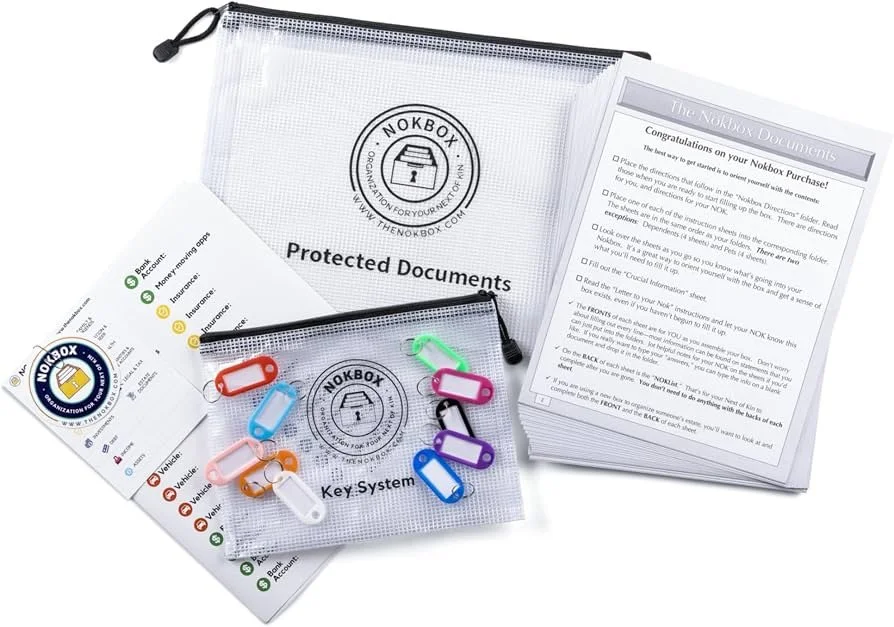
This Nokbox is perfect for organizing important documents and estate planning!
Step 4 — Get Organized with a System That Works
Following my sister's lead and my own recent experience of getting properly organized, I found an organizer on Amazon called NokBoxand it has been genuinely transformative.
Everything is in one place: our trust, our deeds, our car titles, birth certificates, marriage certificate, passports, insurance documents, the master document — all of it, organized, accessible and ready. There are options for an actual box or a pouch. Choose what works best for you.
Here is the detail I love most about this system: if we are ever dealing with a disaster of any kind — a hurricane, a fire, an emergency evacuation — the box comes with us. Everything important in one portable, organized container. No hunting through filing cabinets. No wondering what you've forgotten. The box goes. Everything goes with it.
I also keep a digital copy of the master document in a secure, password-protected location that my husband and our designated executor can access.
Step 5 — Have the Conversation
This is the step most people skip entirely and it is, arguably, the most important one.
Tell the people who need to know what they need to know.
Tell your executor where your documents are and what your wishes are. Tell your children — adult children especially — what they can expect and what you expect of them. Have the conversations about sentimental items before those decisions have to be made in grief rather than love. I’ve witnessed this situation first hand, and it made it clear to me I will not let my loved ones go through that sort of pain.
These conversations are uncomfortable. They are also one of the most loving things you can do for the people who will have to navigate your affairs someday. My sister did not just give me a document. She gave me the gift of clarity. Of not having to search, or guess, or wonder. Of being able to focus on grieving rather than administrating.
That is an act of extraordinary love.
Do that for your people.
Step 6 — Review Every Year
Put it in your calendar. Every January, every birthday, every anniversary — pick a date and make it the annual estate plan review. Twenty minutes to check that everything is still current, still accurate, still reflects your wishes and your life.
Twenty minutes once a year.
For everything it protects.
What My Sister Taught Me
I wanted to help my sister and ended up being helped by her instead.
She taught me that being organized is not just about knowing where things are. It is about making things as easy as possible for the people you love at the hardest possible time. It is about removing the administrative burden from grief so that grief can be what it needs to be — felt, not managed.
I have my NokBox now. I have my master document, updated and complete, including the accounts I had somehow forgotten existed.
I thought I had this handled. My sister showed me what actually having it handled looks like. I am catching up. So can you.
The Rebel Age Estate Planning Checklist
Print this. Put it somewhere useful. Work through it one item at a time.
☐ Will — created and current
☐ Durable Power of Attorney for Finances — in place
☐ Healthcare Directive — completed and shared with family and doctor
☐ Trust — evaluated with attorney, implemented if appropriate
☐ Master document — created and complete with all accounts, policies, passwords and contacts
☐ Nok Box or equivalent — all physical documents organized in one portable place that can go with you easily in a disaster
☐ Digital backup — master document stored securely and accessible to executor
☐ Executor informed — they know where everything is and what your wishes are
☐ Family conversation — the people who need to know have been told what they need to know
☐ Annual review — scheduled and recurring
💬 Have you had your estate planning moment? The one that made you realize you had more to do than you thought? Tell me in the comments. And if you have a system that works — share it. Every woman reading this needs to hear it.
With Rebel Love — Jeannie
This post contains affiliate links. All recommendations are genuine and personal.